🏆 Accepted at ECCV 2026 🏆

PECA

A Benchmark for Heterogeneous Stereo Deblurringwith Physically- and Epipolar-constrained Cross Attention

1Pukyong National University    2Konkuk University
*Equal contribution   Corresponding author

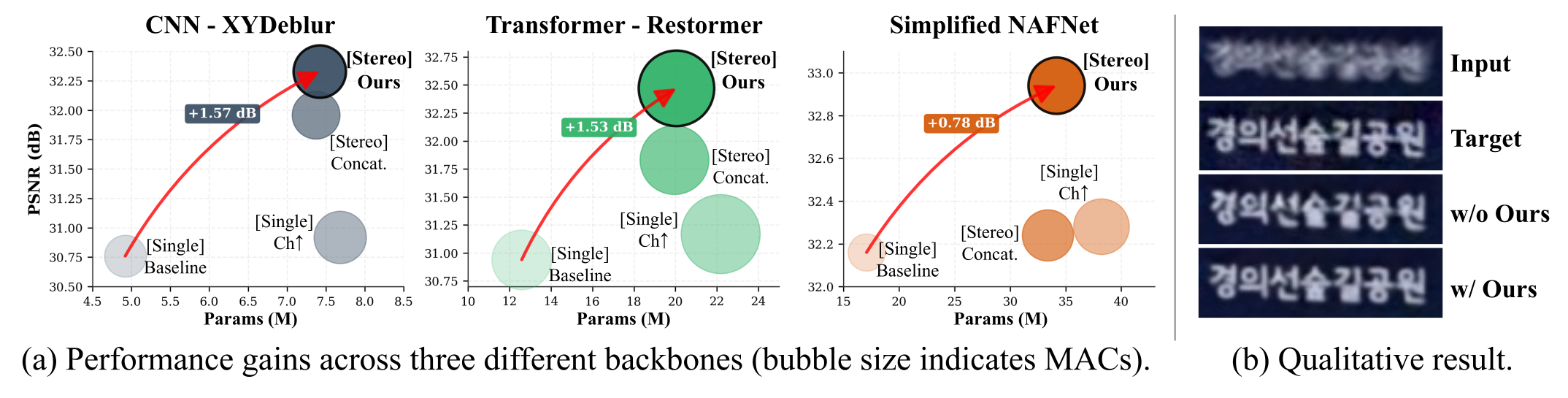
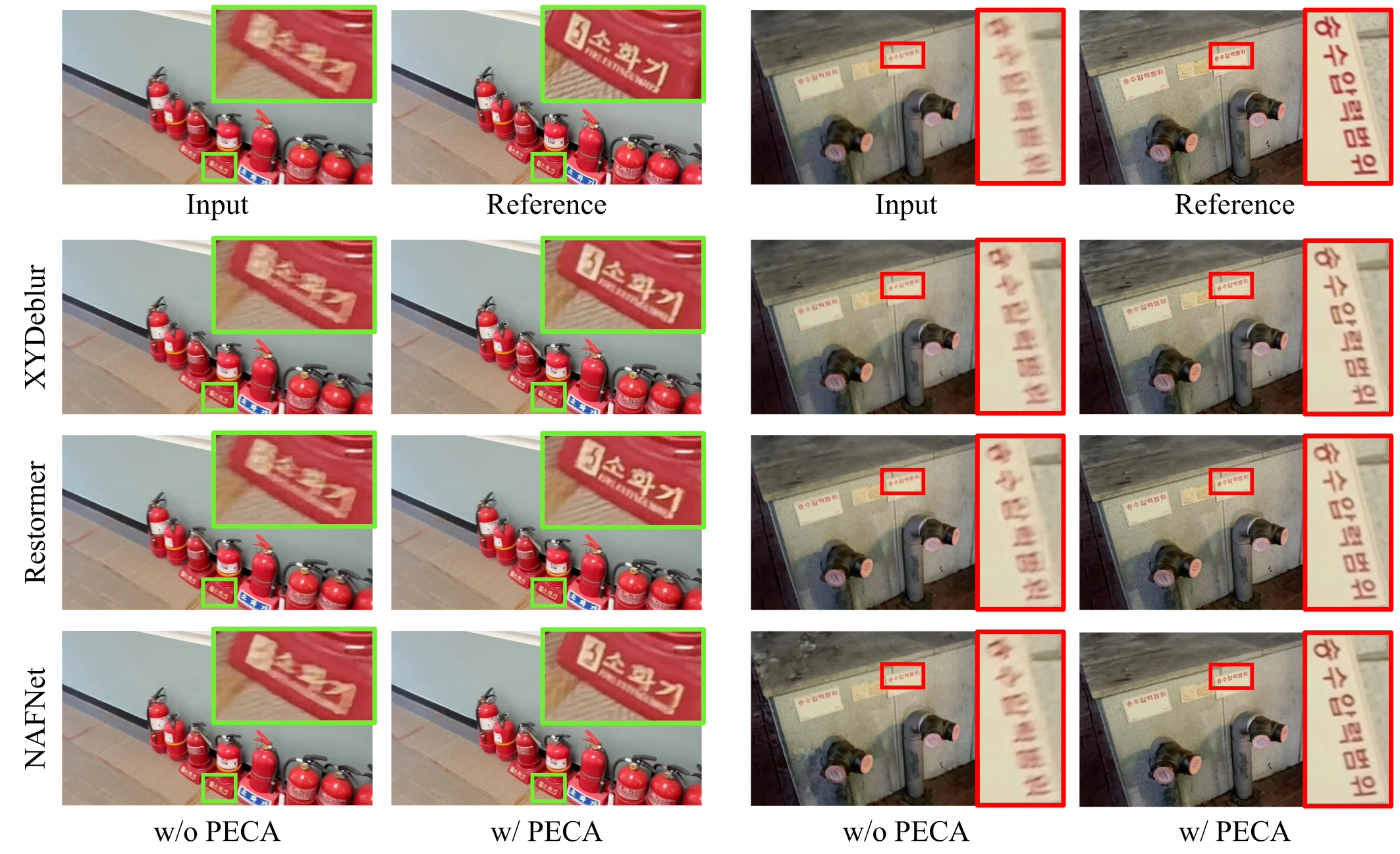
PECA performance gains across XYDeblur, Restormer, and NAFNet with a qualitative deblurring comparison

A sharper wide camera can guide a blur-degraded ultra-wide camera—if cross-view attention searches only where a physically valid match can exist.

Heterogeneous cameras need a heterogeneous benchmark.

Modern smartphones pair camera modules with very different optics and stabilization. The primary wide camera often produces a sharp view, while the ultra-wide camera—typically without optical image stabilization—suffers stronger motion blur. Existing stereo benchmarks largely assume two homogeneous cameras and do not capture this asymmetric degradation.

We introduce the Heterogeneous Stereo Deblurring (HSD) dataset and PECA, a lightweight, architecture-agnostic cross-view fusion module. PECA limits correspondence search to a directional epipolar window bounded by camera optics, retrieves reliable details from the sharp reference, and falls back to self-deblurring where correspondence is uncertain.

Real captures, controlled blur.

HSD is built from synchronized, device-rectified wide and ultra-wide smartphone videos. Temporal integration simulates exposure-induced ultra-wide blur while the center frame provides the sharp target.
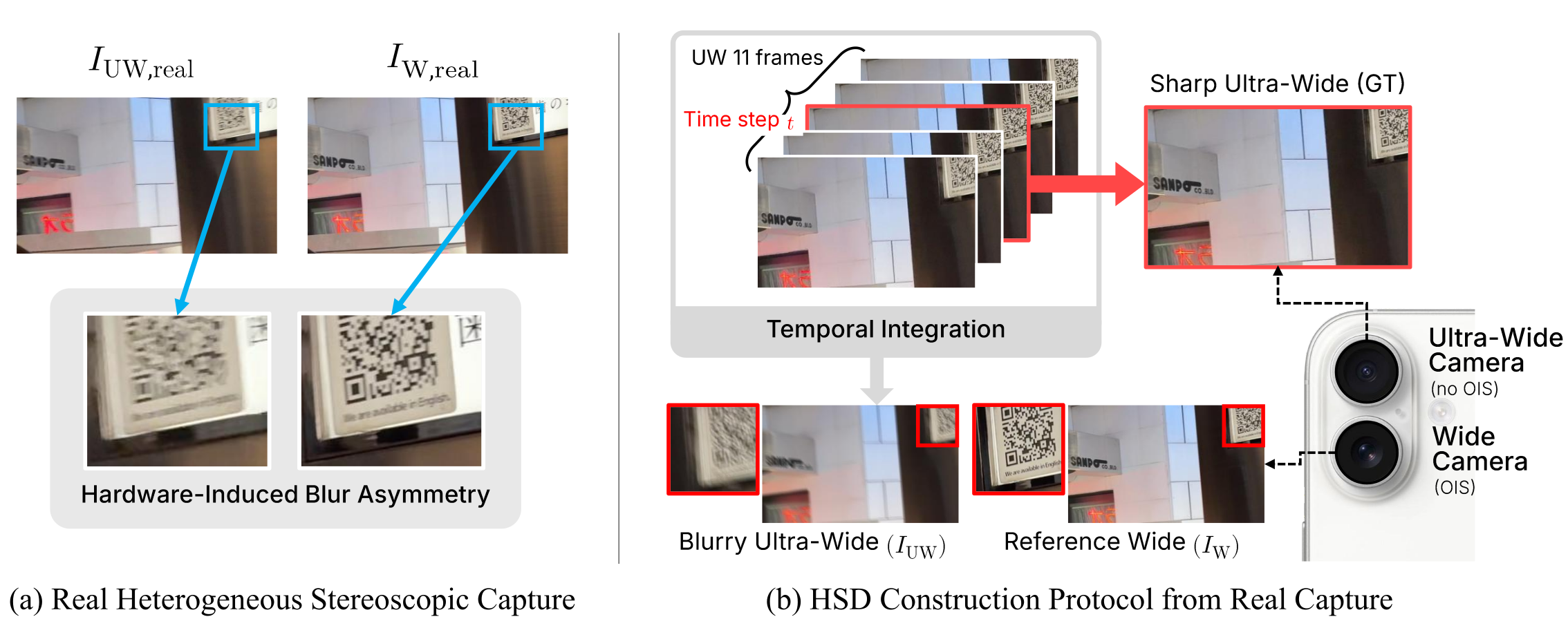

HSD benchmark construction from real heterogeneous smartphone stereo captures
Hardware-induced blur asymmetry and the HSD construction protocol.
Diverse scenes and capture conditions in the HSD dataset
HSD contains diverse indoor and outdoor scenes, lighting conditions, motion patterns, and depth distributions.
384captured sequences
2,200training pairs
1,100test pairs

Search less. Match better.

Rectification restricts correspondence search to a single epipolar line, while camera geometry provides a physical upper bound on disparity. PECA combines both constraints to remove implausible candidates before computing attention.
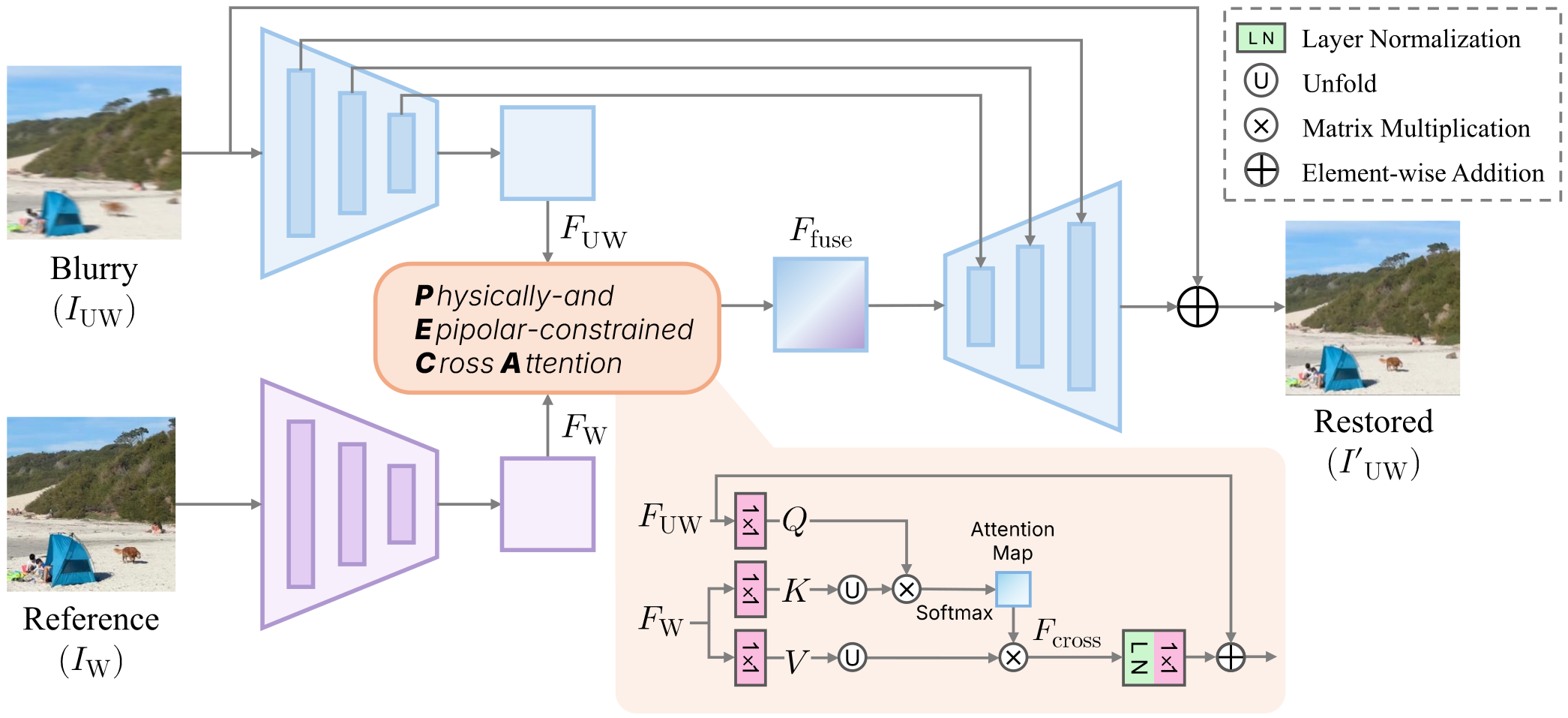
Overall PECA architecture for heterogeneous stereo deblurring
Overall architecture. PECA retrieves cross-view features from the sharp wide-camera reference.
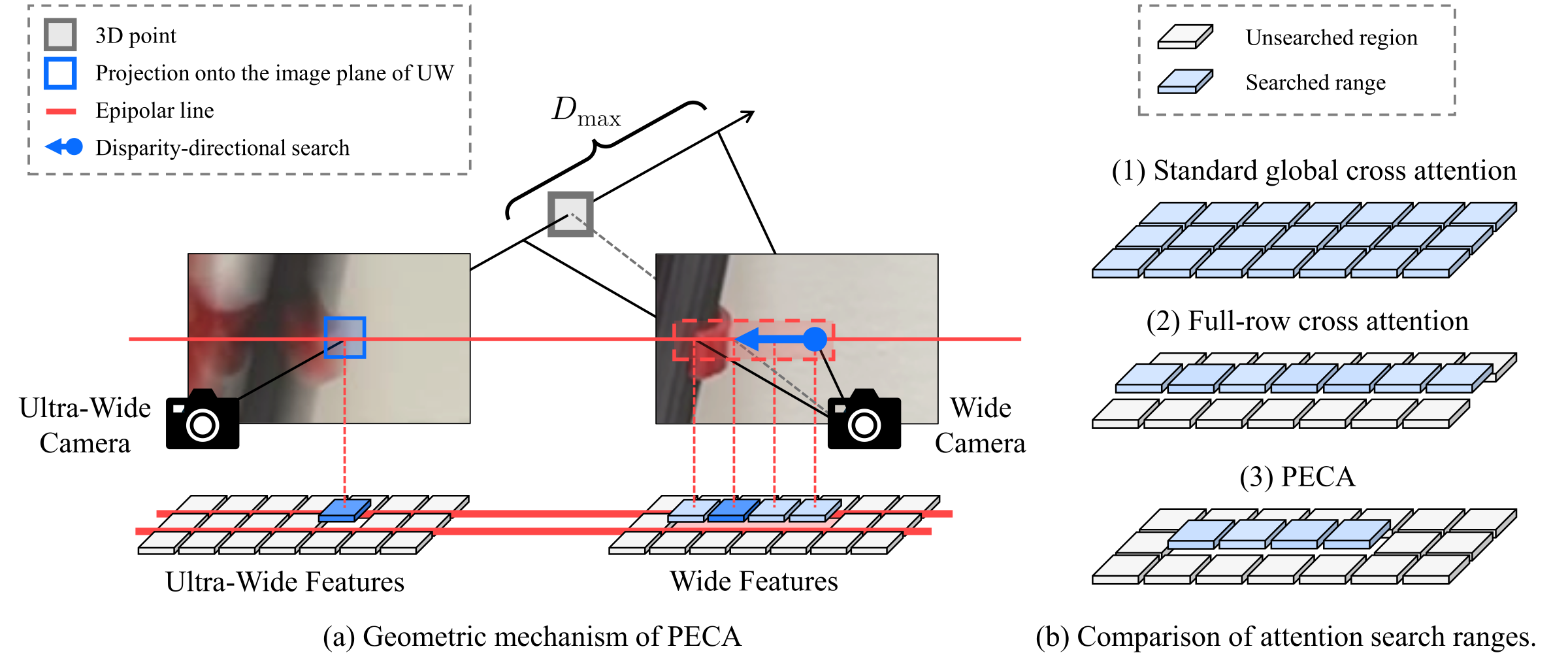
PECA geometric mechanism and comparison of attention search ranges
PECA searches a bounded, one-sided interval instead of the full image or full scanline.
deff=max(dminW,dminUW) Dphys=f·Bdeff×1S,DmaxDphys

The physical disparity bound is Dphys ≈ 11 pixels at the feature scale, corresponding to approximately 44 pixels at the input scale (S = 4).

f: focal lengthB: baseline distanceS: down-sampling factor
1

Physical bound

Derive the maximum disparity from camera geometry and the effective minimum depth.

2

Epipolar search

Restrict keys and values to a directional 1D window along the rectified scanline.

3

Residual fusion

Inject reference details according to attention weights while preserving target-view features.

Consistent gains across architectures.

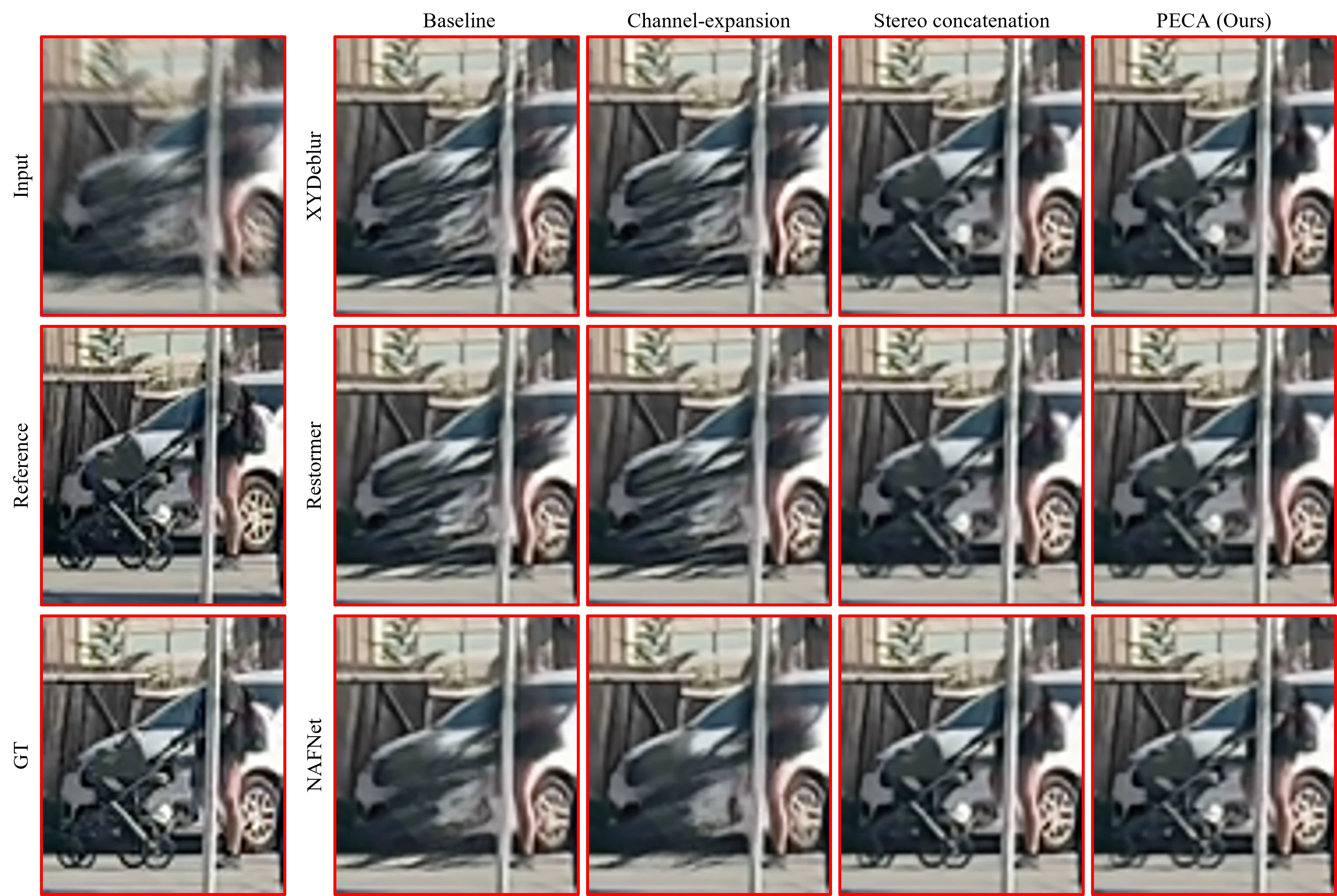
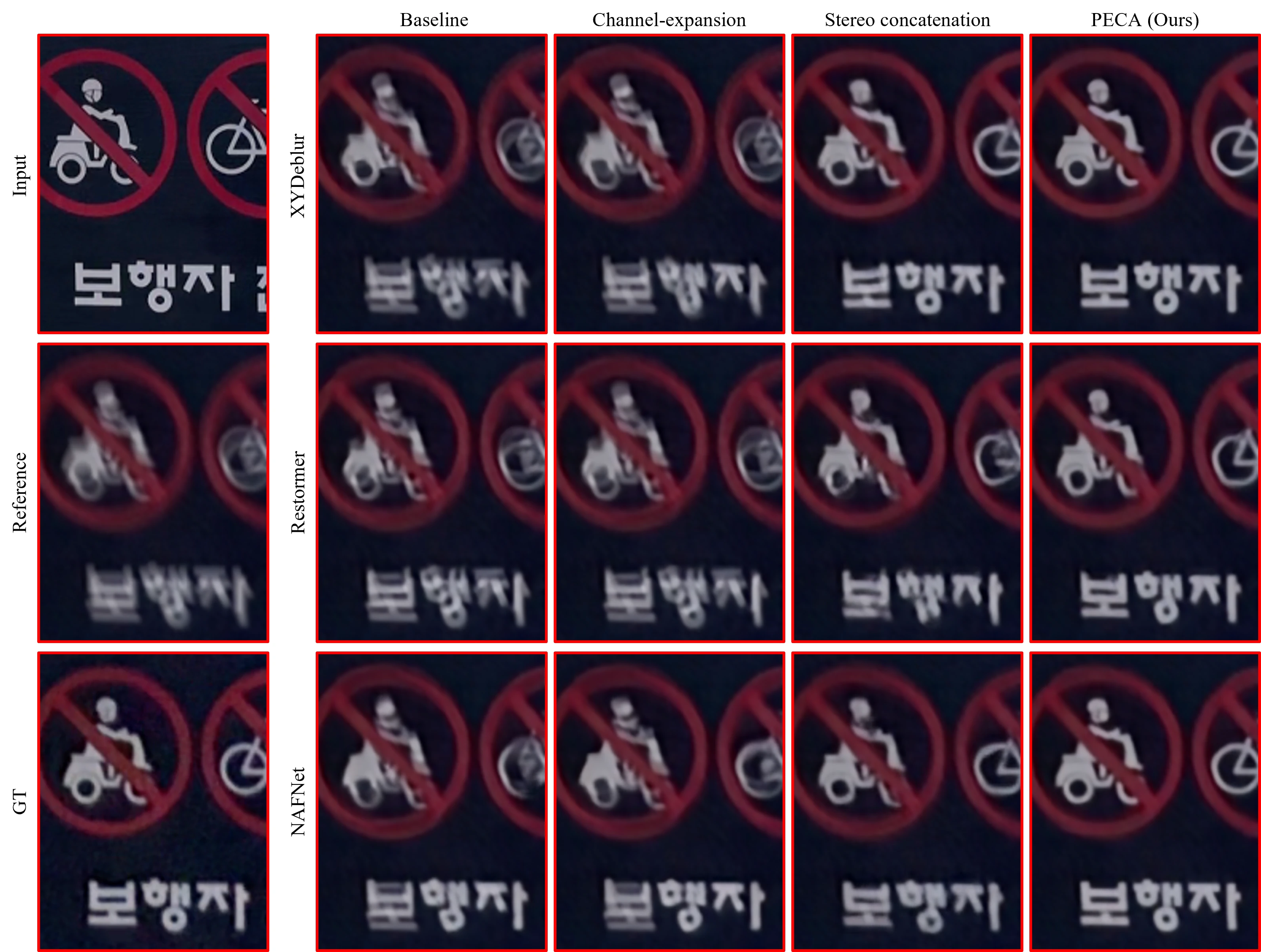
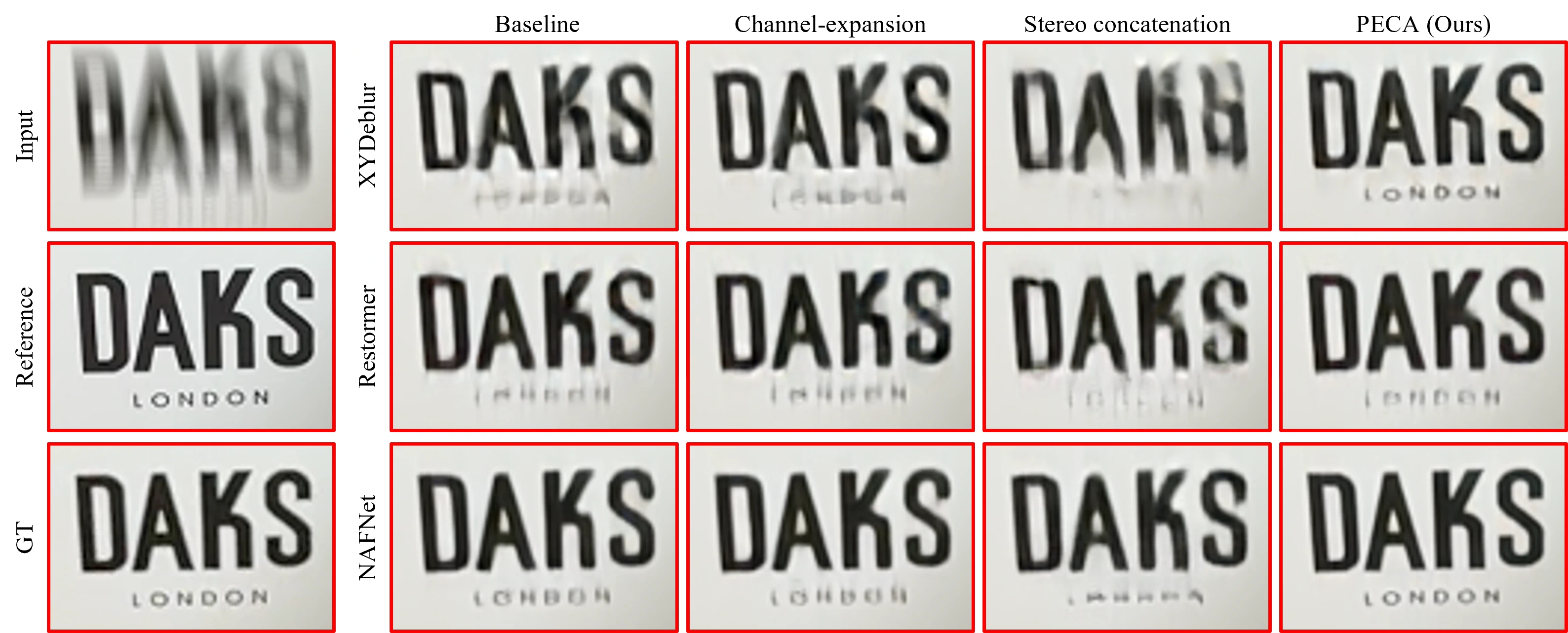
PECA consistently achieves the best restoration performance across XYDeblur, Restormer, and NAFNet, outperforming both increased model capacity and naive stereo fusion.
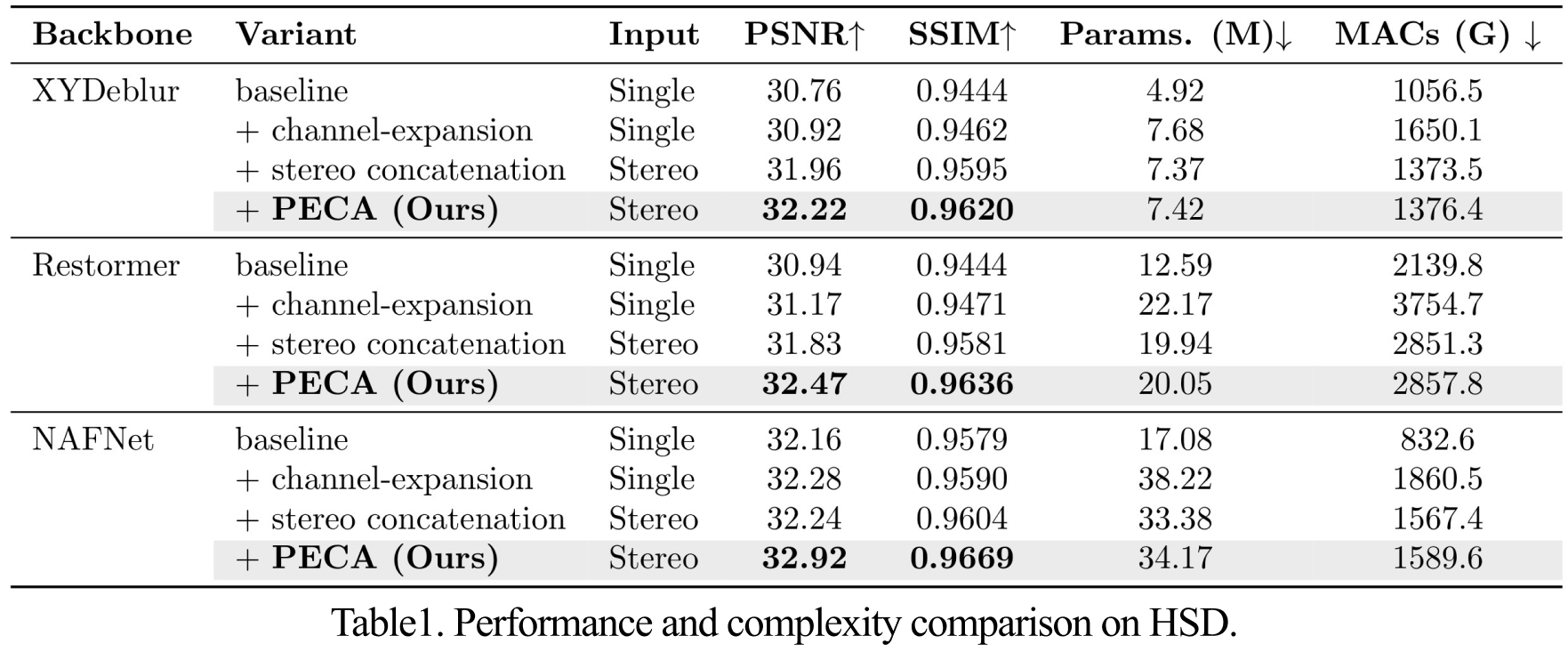
Performance and complexity comparison across XYDeblur, Restormer, and NAFNet variants
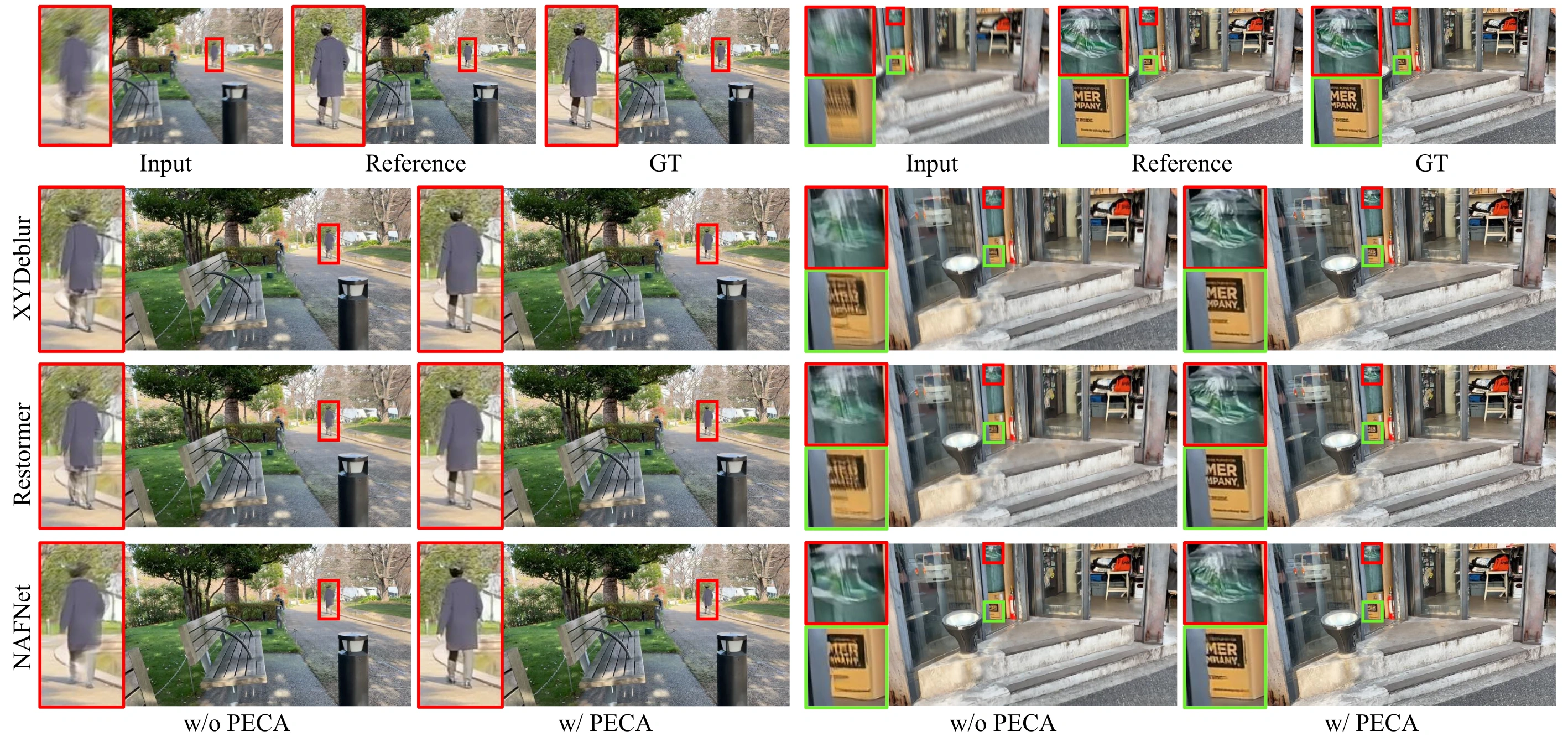
Qualitative PECA comparisons across deblurring architectures
PECA restores sharper structures across diverse deblurring architectures.
Additional PECA benchmark result 1
Additional qualitative comparison on the HSD benchmark.
Additional PECA benchmark result 2
Additional qualitative comparison on the HSD benchmark.
Additional PECA benchmark result 3
Additional qualitative comparison on the HSD benchmark.

Sharper details in real handheld captures.

PECA consistently restores sharper details across different backbones on real handheld stereo captures.
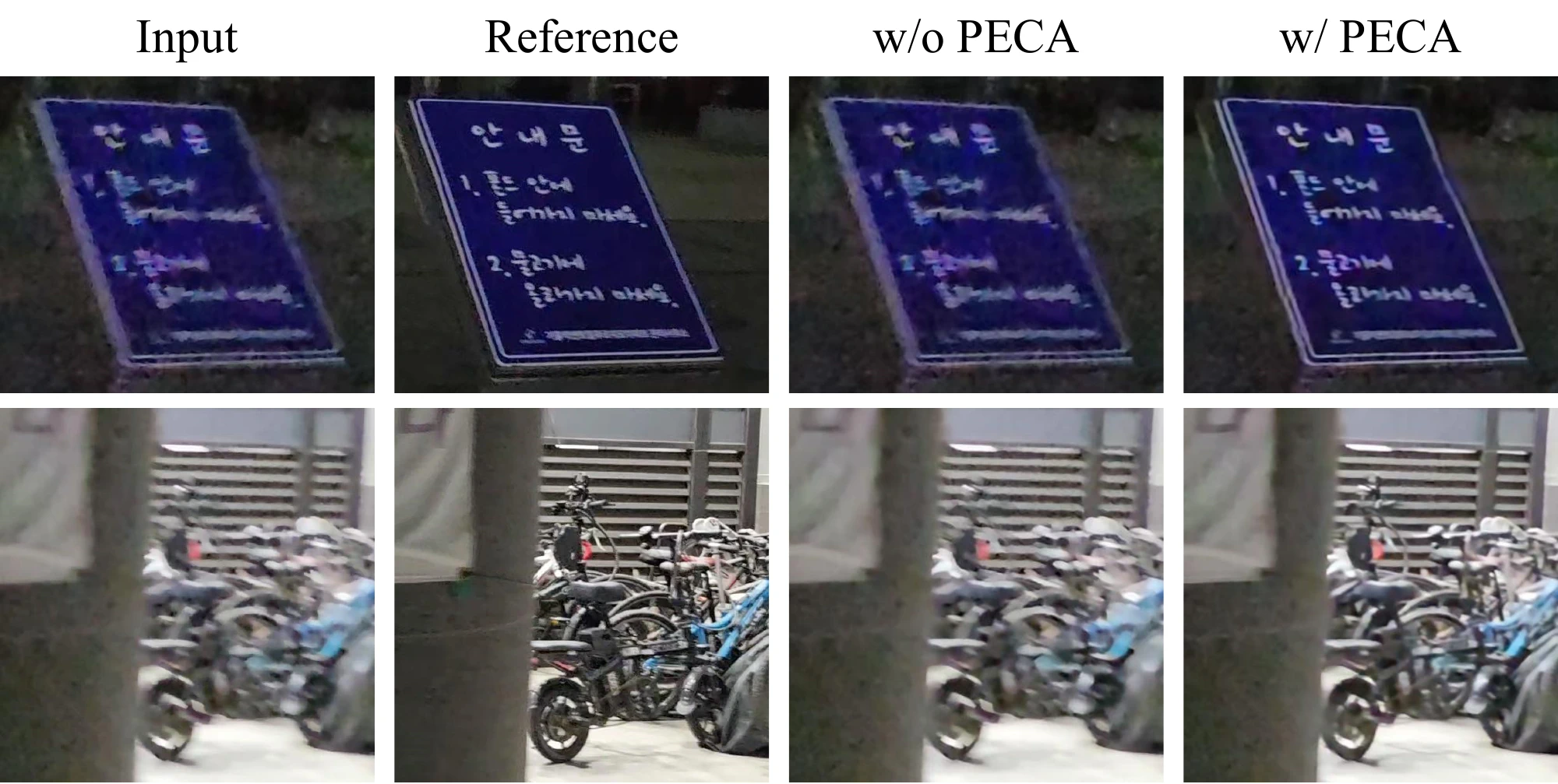
Real handheld PECA deblurring results
Real handheld stereo deblurring results with PECA.
Real-world comparison with and without PECA
Qualitative results on real blur captured by unseen device(Galaxy S25) on XYDeblur.

Constrained search improves accuracy and efficiency.

PECA restricts matching to a geometrically plausible disparity window, achieving +1.50 dB and +1.47 dB over global and full-row attention, respectively, with 294× and 2.6× lower module computation.

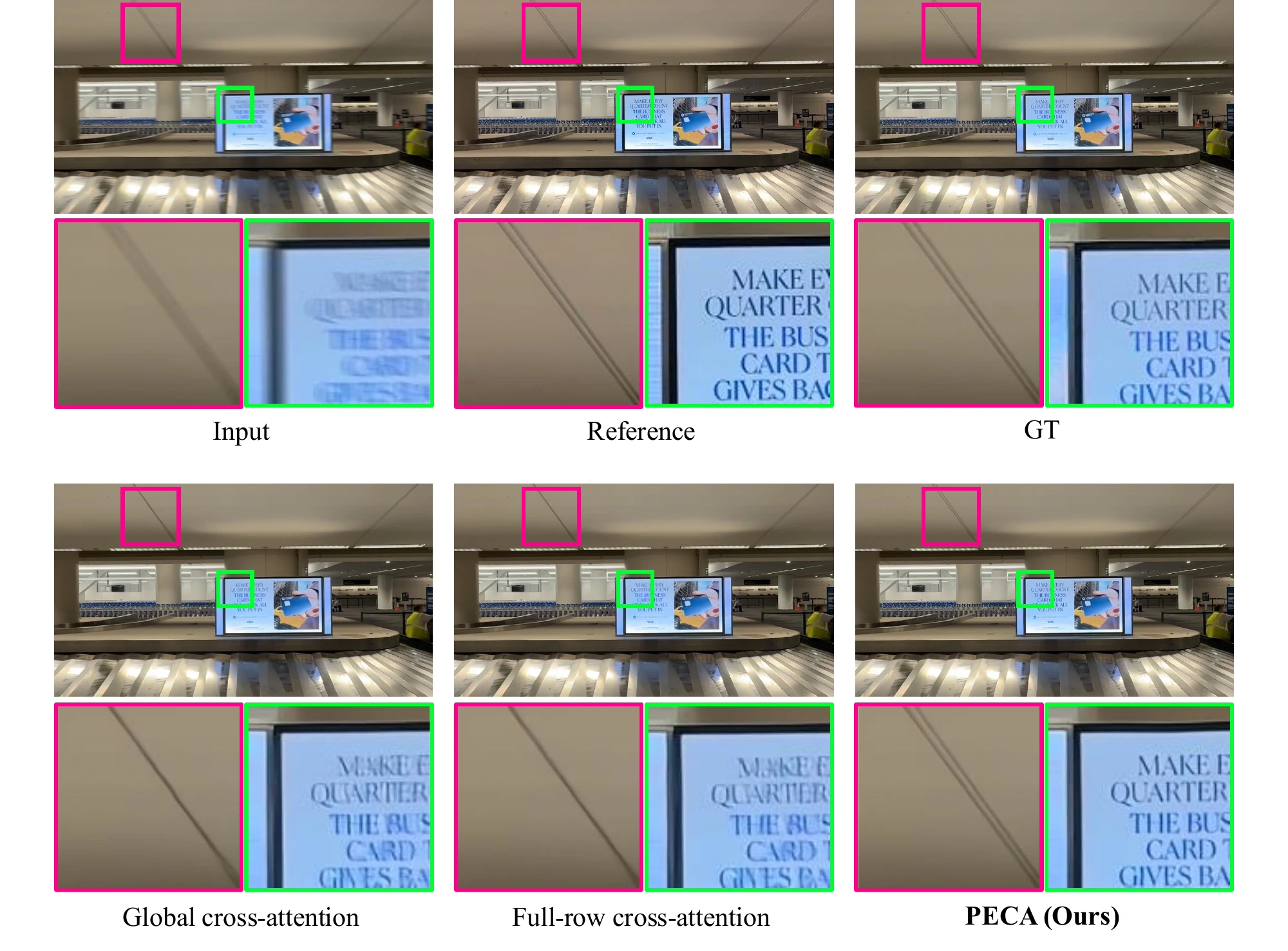
Effect of search-space design on deblurring performance and computational complexity
Comparison of global, full-row, and PECA cross-attention
Comparison of global, full-row, and physically constrained PECA search ranges.

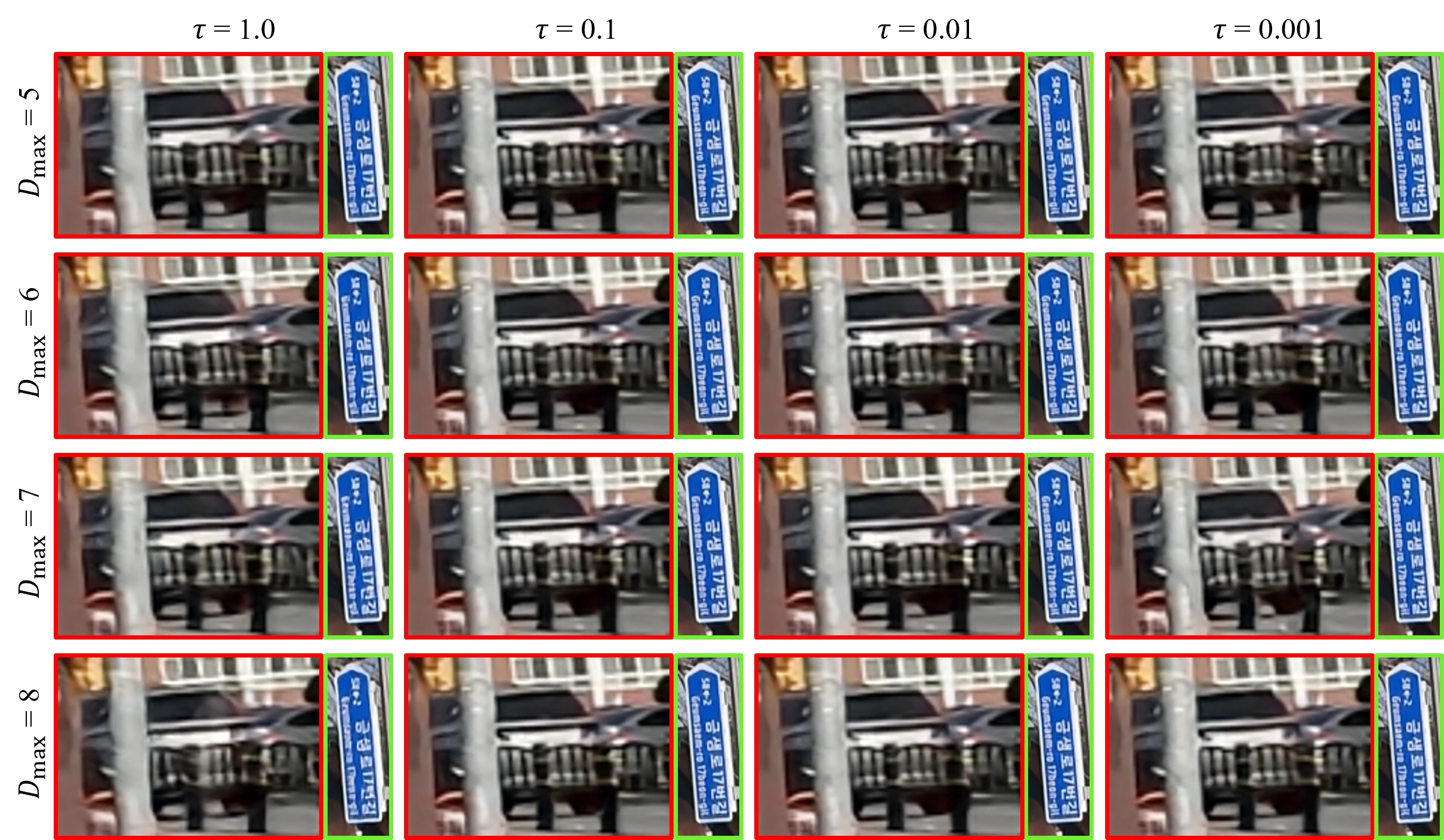
Robust across search bounds and temperatures.

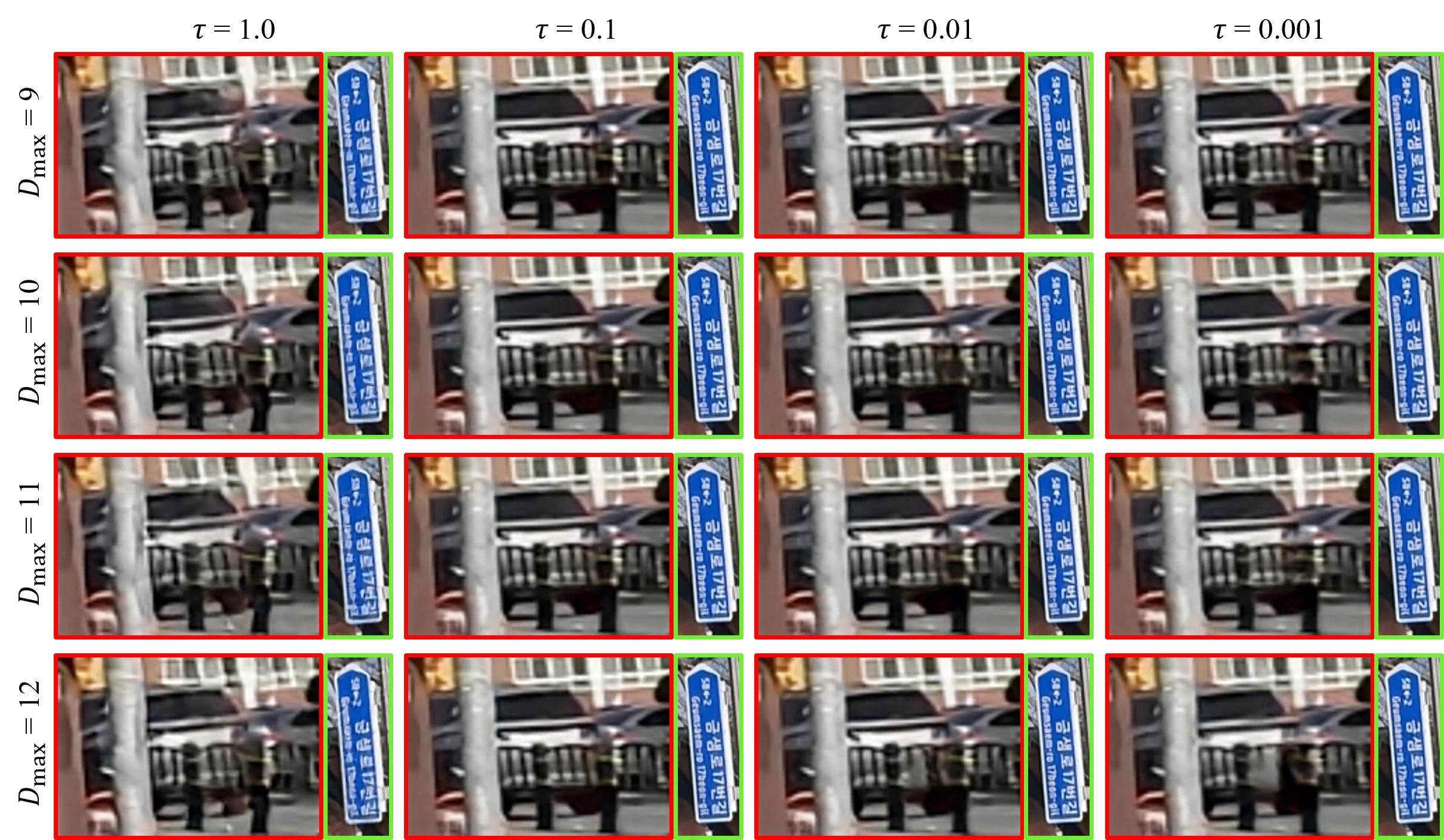
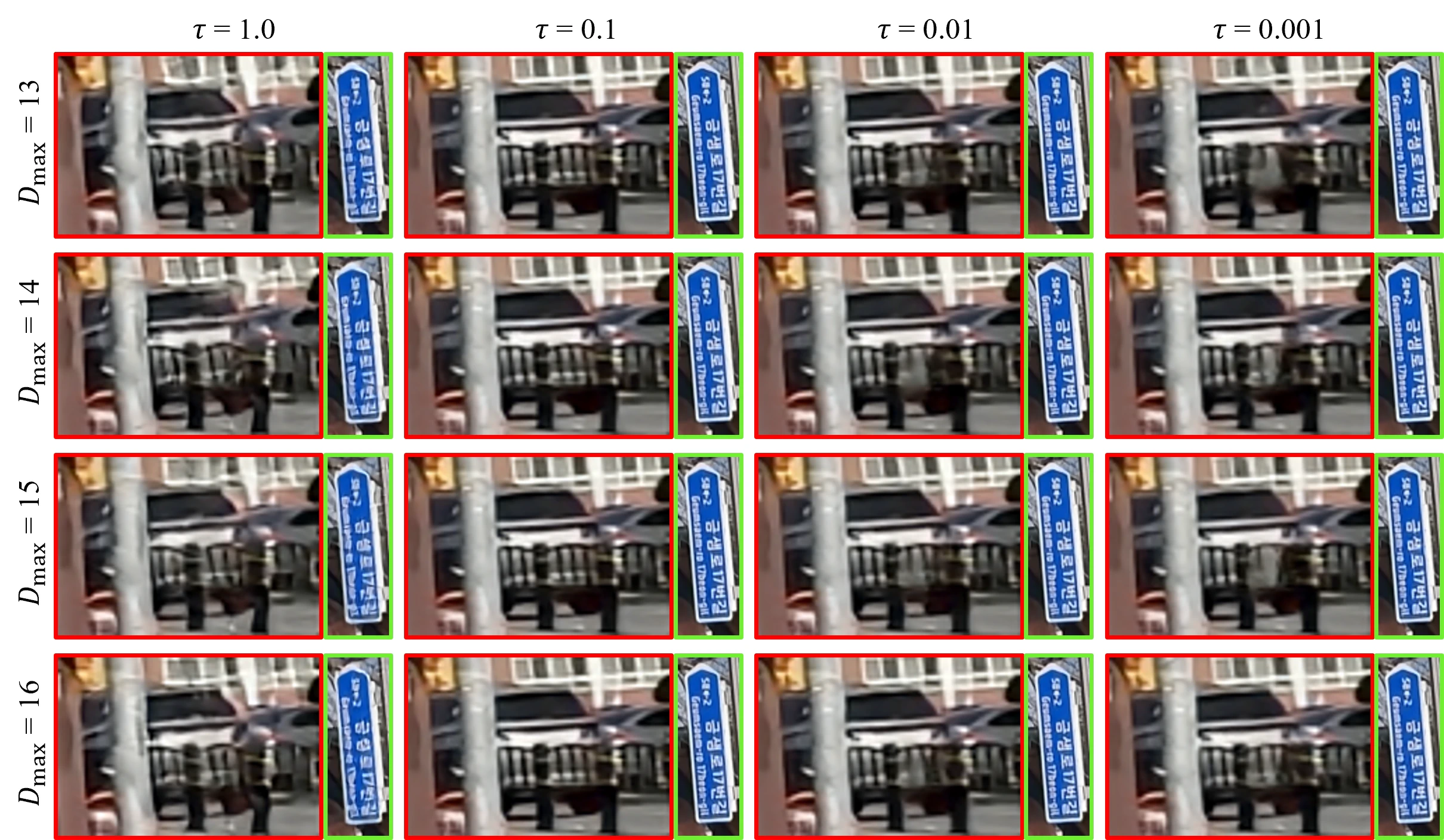
PECA performs consistently across a wide range of Dmax values when the attention distribution is sufficiently sharp. We use Dmax=5 and τ=0.01 as practical defaults, balancing restoration accuracy and attention cost.

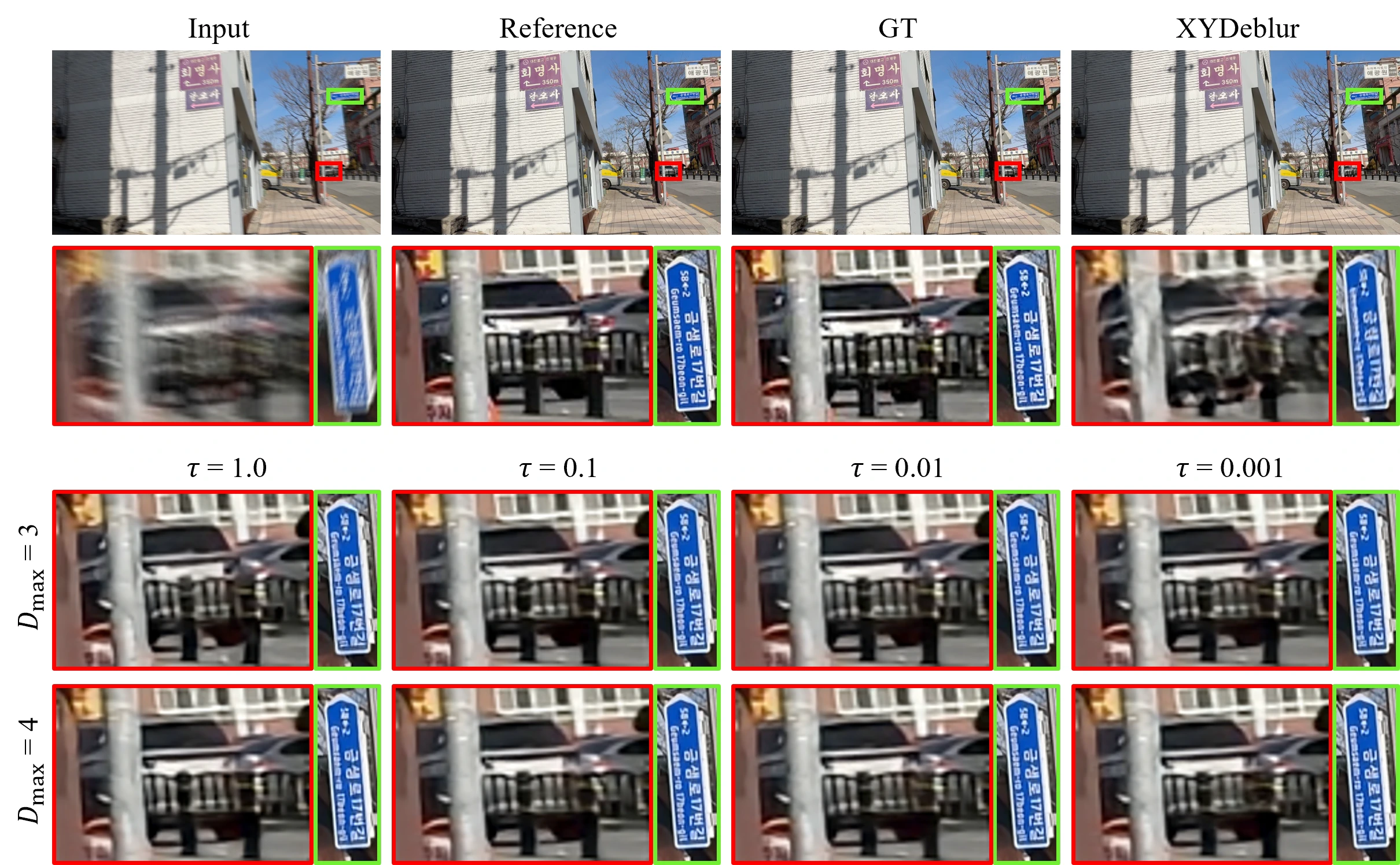
Sensitivity analysis for disparity threshold and temperature
Sensitivity analysis over the maximum disparity threshold and attention temperature.
Sensitivity analysis example 1
Attention sensitivity visualization for Dmax = 3–4 under different softmax temperatures τ.
Sensitivity analysis example 2
Attention sensitivity visualization for Dmax = 5–8 under different softmax temperatures τ.
Sensitivity analysis example 3
Attention sensitivity visualization for Dmax = 9–12 under different softmax temperatures τ.
Sensitivity analysis example 4
Attention sensitivity visualization for Dmax = 13–16 under different softmax temperatures τ.

BibTeX

@inproceedings{shin2026peca,
  title     = {A Benchmark for Heterogeneous Stereo Deblurring with
               Physically- and Epipolar-constrained Cross Attention},
  author    = {Shin, Hoju and Kim, Jiah and Kim, Seung-Wook and Ji, Seowon},
  booktitle = {European Conference on Computer Vision (ECCV)},
  year      = {2026}
}